Do I have to keep a journal?
Of course not - you don't have to do anything! But food for thought - famed poet and civil rights activist, Maya Angelou, once wrote, "I have great respect for the past. If you don't know where you've come from, you don't know where you're going." For many, keeping a journal is the best way to keep track of everything you learn while on your journey. As we discuss in the book, the keys that will help you crack your code are often in the small details. Taking notes and monitoring progress will allow you to identify these keys much quicker. Of course this will take some time and extra effort. But remember, you are a weight loss detective who is trying to solve a case that, up until now, has not been solved - the answers aren't always easy to find but they are out there.
Can I just buy a journal?
The short answer is that you absolutely can! However, journals for sale have a set template and structure to them that you would have to conform to. Certain ones may work well for you; however, much like how everyone's weight loss journey is going to be different, so to will the functions and the needs of the journal. This is why I recommend trying to make your own journal - one that includes what's important for you in a way that works for you.
How do I start building my journal?
When creating a system for journaling, the layout of the journal and the content, including what you track and how, is completely up to you.
The first step is to decide on what method of journaling you would like to include. Some people, for example, create their journal pages in Word, giving them the flexibility to tweak pages as they see fit and print out as many copies as needed (i.e. 7 "daily tracking" pages per week, 1 weekly tracking page) and keep them in a binder. Some use technology to their advantage by using apps such as MyFitnessPal for recording Caloric intake and expenditure, MoodNotes for understanding the impact their emotions have on their behaviors and the Notepad app on their phone for writing ideas and observations. While others want to keep technology out of their journaling process entirely. They may create their journal solely with a pen and a Moleskin notebook (I've included it in the "My Favorite Tools" page). Perhaps they even carry around a portable notepad for recording important observations and ideas when they're not at home.
Regardless of how you want to layout your journal, the key is to identify what system you feel will work for YOU! Along those lines, remember to keep your journaling system as simple as possible - if not you'll likely get overwhelmed and stop altogether.
What should I include in my journal?
After you figure out how you will be journaling, the next step is to figure out the layout (if you're not going to be using a bunch of apps). Most, including myself, find it helpful to keep a daily note sheet, where they can record daily tasks, activities and observations. Many also include a weekly planning sheet, where they record metrics such as their weekly intake goal as well as figure out the specific habit(s) they will be tackling. Some even include a monthly planning sheet, where they can review and track habits and results across an entire month, as well as plan for the upcoming month.
Here are some examples of what you might include in your journal - remember these are just ideas to get the juices flowing. You need to figure out what makes the most sense for you.
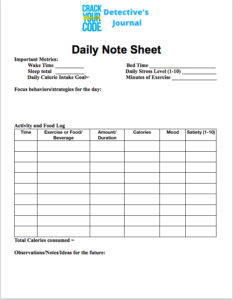
If you wanted to use a Daily Note Sheet, it is usually most effective if it does the following:
- Tracks important metrics for your journey (this could include: amount/quality of sleep, stress levels, minutes of exercise, Calorie targets for the day, a food log)
- Place to identify key behaviors/habits to focus on for that day
- A place to note observations/ideas for future reference (there are always clues along your journey to crack your code, you just need to be open to recognizing them and record them so you don't forget).
If you wanted to keep a Weekly Planner, it could include some of the following:
- Your daily Caloric Intake goals, averaged across the week (remember, not all days have to be exactly the same - it's the average that counts).
- Your daily expenditure goals (mainly through physical activity - since this has the most potential to fluctuate day to day)
- Each week is also a great time to pause and reflect on what behavior(s)/habit(s) you'd like to work on for the week and identifying your Change and Decision Windows for those behavior(s)/habit(s)
- Perhaps you know what habit(s) you'd like to change but are unsure of how...this would be a great time to think through/brainstorm possible options and record them.
- As we discussed in Chapter 5 of the book, once you've identified a strategy to implement, the key is to make it a SMART behavioral goal.
If you also wanted to include a Monthly Planning Sheet, it could include:
- Your goals for the month (both outcome AND process goals)
- Habits you would like to build/change within that month
- Possible strategies you're thinking of experimenting with
- Habit tracker, to check off each day you completed a particular strategy/habit (so you can see trends and progress across the whole month)
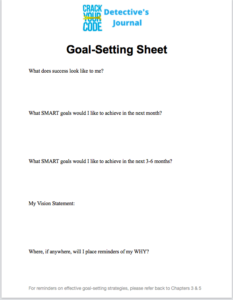
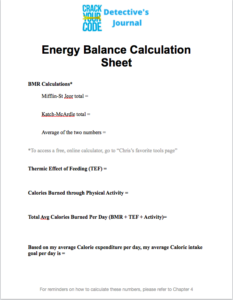
Somewhere in your journal (many do it at the beginning), you want a page dedicated to Goal-setting (including your Vision Statement). It is also helpful, towards the beginning, to calculate and have a place to record your key numbers, such as Basal Metabolic Rate (BMR), Thermic Effect of Feeding (TEF), average Caloric expenditure from physical activity (NEAT and Exercise), as well as your Caloric intake targets (created based on your total Caloric expenditure).
Looking for an easier way to get started?
If, after reading this, you're thinking "I have too much else on my mind to think about creating my own journal," then I've made it easier for you. Everybody seems to be selling a journal for tracking weight loss, habits, productivity, career success - some selling for close to $50. Rather than having to spend money on a prebuilt journal whose template won't have space for you to track everything that we just mentioned, I've built the important pages for you already and included them at the bottom. You can click on each picture below and print them yourself, for FREE. You can put them into a binder and have a pretty nice journal without having to spend an extra penny. When doing this, the order I would suggest would be:
- Goal-setting Sheet
- Energy Calculation Sheet
- Monthly planner (at the beginning of each month, diving your journal into months)
- Weekly Planner (at the beginning of each week - diving your journal into weeks)
- 7 Daily Note Sheets (one for each day of the week, to go between your weekly sheets)